
Taking a Closer Look
See the fuller picture of what you’re noticing
Before we go further…
A lot of what we hear about substance use is confusing.
It often sounds like “fine” or “addiction,” with nothing in between.
But substance use is part of health.
Like other health issues, it exists on a range and can change over time.
Real life is usually more mixed than what we are shown and told.
Here, you can slow down and see the bigger picture.
What You’ll Find Here
A simple way to see the full range of substance use Clear explanations of ideas that often get oversimplified A few gentle questions to help you notice patterns
You don’t have to label anything.
You don’t have to decide anything today.
Just start by looking more closely.
This is most important section and needs to look like the pic I shared so it has the right weight and impact.
The conversation about substance use has been missing most of the picture. Here is more of it.
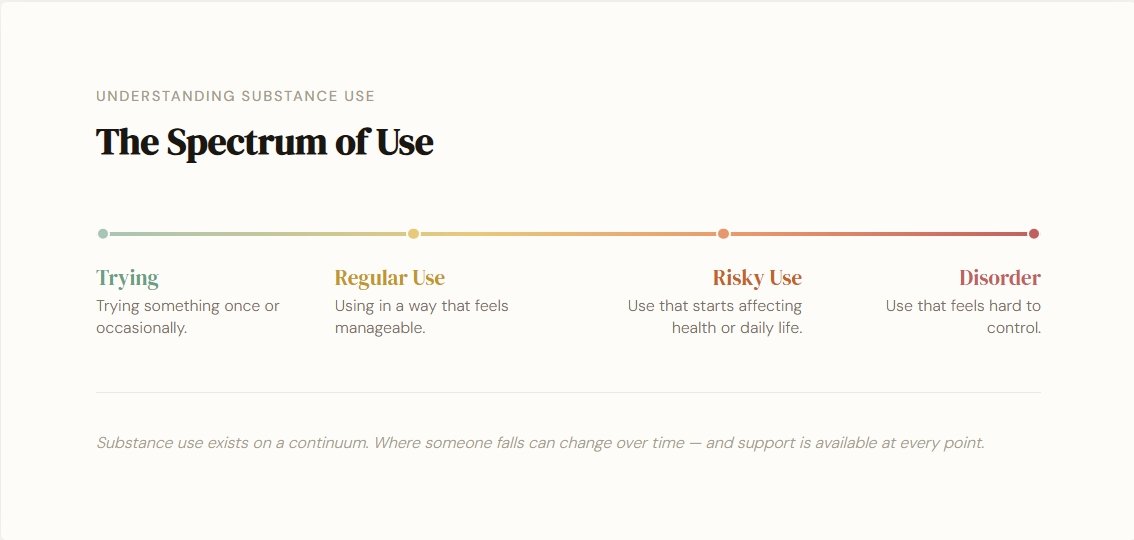
we need to create this in our own branded colors and to best work here and drop in as an image
Most people who use substances never develop a disorder. But we built a public health system around the ones who do and left everyone else without a map. That gap does not just affect the majority. It affects everyone. When accurate information is hard to find before things get serious, the path to serious gets shorter.
“People resist help when they feel forced. When we offer information and choices, they are more likely to engage.”
-
The Whole Story
Substance use is often talked about in simple terms.
But health is rarely simple.
Most people hear about substance use at the far end of the spectrum.
What’s talked about less is everything in between.The continuum helps explain:
• Why not all use looks the same
• Why patterns matter more than labels
• Why change can happen gradually
• Why support can look different at different pointsWhen we see the whole story, we respond more thoughtfully.
Clear understanding helps people make decisions that fit real life.
-
Substance use exists on a spectrum.
Not all use leads to disorder.
Most people fall somewhere in between.Where someone falls can change over time.
Understanding the range helps you see what you’re noticing more clearly.
No labels are needed here.
Just awareness of the full picture. -
Movement along the spectrum happens over time.
Substance use becomes more concerning when patterns shift.
It’s less about one event and more about:
• Using more often
• Needing more to feel the same effect
• Use starting to affect health or daily life
• Feeling less in controlThese changes suggest movement along the continuum.
Not a judgment.
Not a diagnosis.
Just information.Noticing early supports steadier decisions.
Why there is so much confusion? EYEBROW
Substance use is a health issue.
It has not always been treated like one.
“Trauma, genetics, mental health, these aren’t moral weaknesses. They’re risk factors, just like high cholesterol increases your risk for heart disease.”
This is what it looks like when the picture gets clearer.
What is proven is clearer than what most of us have been told.
For a long time the conversation about substance use was built around punishment, not health. Around who deserved care and who did not. Most of the information people have was designed for a crisis. Not for everyday life. Not for the questions most people actually have. That is not your fault. It is what was built.
Not ready to keep going? That is fine too. Come back when it feels right.